
 Dane
Dane
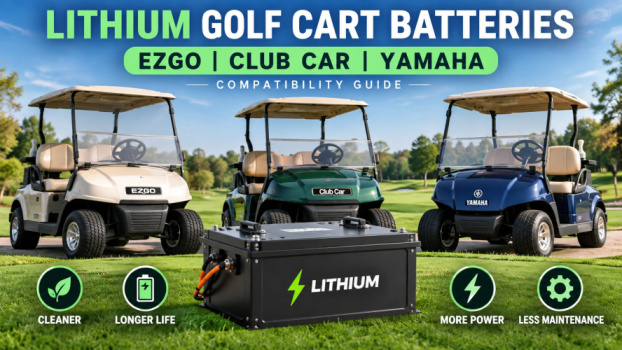
Can you replace your golf cart’s lead-acid batteries with lithium without changing the whole cart? Yes, in many cases. The key is matching the battery voltage, cart model, battery dimensions, BMS, controller, and charger. EZGO, Club Car, and Yamaha each have different generations, so compatibility depends on the exact cart.
Lithium golf cart batteries can work with many EZGO, Club Car, and Yamaha models, but they are not universally interchangeable. A 36V cart needs a compatible 36V lithium system, while a 48V cart needs a 48V system. You should also verify the battery tray, terminals, charger, controller, and required conversion hardware before buying.
⚡ Why Lithium Battery Compatibility Matters
Lithium batteries are not simply smaller replacements for lead-acid batteries. Your golf cart’s electrical system was designed around specific voltage and charging requirements. Installing the wrong battery can cause poor performance, charging problems, or BMS protection shutdowns.
The good news is that many modern lithium conversion kits are designed around popular golf cart platforms. LiFePO4 lithium batteries are especially common in aftermarket golf cart upgrades. They can reduce weight, remove watering duties, and provide more consistent power during use.
Before ordering, check these basics:
- Cart brand and exact model
- Model year or serial number
- Original battery voltage
- Battery compartment dimensions
- Controller specifications
- Charger compatibility
- Battery management system (BMS)
🏌️ EZGO Lithium Battery Compatibility
EZGO has used several electrical platforms over the years. Popular models include TXT and RXV, but their battery systems are not identical. For example, EZGO currently offers 48V TXT models and RXV models, while factory lithium versions can use specialized lithium powertrains.
This means you should never order a lithium battery based only on the word “EZGO.” Your exact model matters. An aftermarket battery advertised for an EZGO TXT may not be the correct physical or electrical fit for an RXV.
| EZGO Platform | Common System | Lithium Upgrade Check |
| TXT | 36V or 48V, depending on generation | Match exact voltage |
| RXV | Commonly 48V | Verify RXV-specific fit |
| Freedom TXT | 48V on current versions | Check battery and charger |
| Newer ELiTE models | Specialized lithium system | Follow factory specifications |
Tip: Check the serial number and existing battery configuration before purchasing. 🔎
🔋 Club Car Lithium Battery Compatibility
Club Car offers several platforms, including DS, Precedent, Tempo, and Onward. Compatibility depends heavily on the cart generation and electrical setup. Current Club Car Onward models, for example, are available with lithium powertrains, while traditional electric versions can use six 8V batteries in a 48V system.
Aftermarket lithium batteries can be available for popular Club Car models. However, physical fit is only one part of the equation. The battery must also work correctly with the cart’s controller, charger, wiring, and other electronics.
Club Car’s factory lithium systems also use sophisticated battery management and vehicle control electronics.
🔌 Yamaha Lithium Battery Compatibility
Yamaha golf carts are another area where model identification is important. Older Yamaha electric carts can use 36V systems, while later platforms such as the G19, G22, Drive, and Drive2 commonly use 48V systems.
That difference makes voltage identification essential. A lithium battery designed for a 48V Yamaha should not be installed into a 36V system simply because the battery physically fits.
For older Yamaha models, a model-specific lithium conversion kit can simplify installation. Always confirm the exact model and voltage before ordering.
📋 36V Vs. 48V Lithium Batteries
One of the most important compatibility checks is voltage. Lithium batteries are sold for different golf cart electrical systems, including 36V and 48V applications.
A 48V battery is not a direct substitute for a 36V battery. The charger and other electrical components must also match the battery system.
| Battery System | Typical Use | What To Verify |
| 36V Lithium | Older golf carts | Cart voltage and charger |
| 48V Lithium | Many newer carts | Controller and charging system |
| 51.2V LiFePO4 | Nominal 48V replacement | Battery manufacturer’s specifications |
| Specialized lithium packs | Factory lithium carts | OEM electronics and BMS |
Important: Nominal voltage and charging voltage are not always identical. Always use the specifications supplied with the battery.
📐 Does Battery Size Affect Compatibility?
Yes. Physical dimensions can make or break a lithium conversion. Lithium batteries are often much lighter than lead-acid packs, but their cases can have different shapes and mounting requirements.
Measure the battery compartment before ordering. Check the length, width, height, terminal position, and mounting points.
You should also consider clearance around cables and connectors. A battery that technically fits may still create problems if its terminals interfere with the seat or surrounding components.
🔧 Do You Need A New Charger?
Sometimes, yes. You should not assume that your old lead-acid charger is automatically compatible with lithium.
Lithium batteries normally require a charging profile suited to their chemistry and BMS. A charger must have the correct output and charging behavior for the specific battery.
When upgrading, check whether the lithium battery package includes:
- A compatible charger
- Charger adapter
- Charging cable
- Onboard charger
- Battery gauge
- Installation hardware
A charger that physically plugs in is not necessarily a compatible charger. ⚠️
🧠 Understanding The Battery Management System
The Battery Management System (BMS) is one of the most important parts of a lithium golf cart battery. It helps protect the battery from conditions such as overcharging, excessive discharge, overheating, and excessive current.
BMS specifications vary between batteries. This matters because golf carts can demand high current when climbing hills, carrying passengers, or accelerating.
For example, factory Club Car lithium systems use BMS technology as part of their overall lithium powertrain.
🚗 Controller And Motor Compatibility
Your battery does not work alone. The motor, controller, solenoid, charger, wiring, and BMS all work together.
A lithium battery may deliver power differently from an old lead-acid battery. Some carts may benefit from controller programming or other conversion components. This is especially important when installing a high-output lithium battery.
| Component | Compatibility Question |
| Battery | Is the voltage correct? |
| BMS | Can it handle the cart’s current demand? |
| Controller | Is it compatible with the battery system? |
| Charger | Does its charging profile match? |
| Wiring | Are cables and terminals suitable? |
| Battery Tray | Does the battery physically fit? |
This system-level approach helps prevent expensive installation mistakes.
⚖️ Lithium Vs. Lead-Acid For Golf Carts
Lithium batteries offer several practical differences compared with traditional flooded lead-acid batteries. They require no routine watering and can provide consistent performance as the battery ages.
Club Car states that its lithium systems are maintenance-free and can charge faster than comparable flooded lead-acid systems.
Lithium batteries can also dramatically reduce battery-pack weight. That can change the overall feel of the cart and may improve efficiency.
💰 What Should You Check Before Buying?
Price should not be your only comparison point. Two batteries with the same advertised voltage can have very different specifications.
Look at usable capacity, continuous current, peak current, BMS rating, warranty, charger compatibility, dimensions, and installation support.
A useful checklist is:
- Identify the exact golf cart model.
- Confirm the original voltage.
- Measure the battery compartment.
- Check the motor and controller.
- Verify the BMS rating.
- Confirm charger compatibility.
- Check terminal placement.
- Review the battery warranty.
- Confirm installation requirements.
- Keep the old battery specifications for comparison.
🛠️ How To Choose The Right Lithium Battery
The safest approach is to buy based on the complete cart configuration rather than the brand alone. For example, searching for “EZGO lithium battery” is less precise than searching for the exact EZGO model and voltage.
The same applies to Club Car and Yamaha. Model + voltage + year or serial number gives you much better information.
If you are unsure, take a picture of the existing battery compartment and record the information printed on the old batteries. That information can help a battery supplier confirm the correct replacement.
🌟 Key Benefits Of A Compatible Lithium Upgrade
When correctly matched, a lithium golf cart battery can provide several advantages. These include less routine maintenance, lower battery weight, consistent power delivery, and potentially faster charging.
Factory lithium systems from manufacturers such as Club Car and EZGO show that lithium powertrains are now available directly from major golf cart manufacturers.
Still, compatibility comes first. The right battery is one that works with your entire electrical system, not simply one that fits under the seat.
🏁 Final Thoughts On Golf Cart Battery Compatibility
Choosing lithium golf cart batteries for EZGO, Club Car, or Yamaha starts with identifying your exact cart. Voltage is the first major checkpoint, but it is not the only one. Battery dimensions, BMS capability, controller requirements, wiring, and charger compatibility all matter.
For a smooth conversion, match the battery to the specific model and electrical system. When those components are properly matched, lithium can be a practical upgrade from traditional lead-acid batteries. 🔋
❓ FAQs About Lithium Golf Cart Batteries
Can EZGO use a lithium battery?
Yes, many EZGO golf carts can use lithium batteries. The battery must match the cart’s voltage and model. Charger and controller compatibility should also be checked.
Can Club Car take lithium batteries?
Yes, many Club Car models support lithium upgrades. Compatibility depends on the model and electrical system. Always verify battery dimensions and charging requirements.
Can Yamaha golf carts use lithium?
Yes, lithium conversion kits are available for many Yamaha carts. Older and newer Yamaha models can use different voltages. Confirm the exact model before purchasing.
Do lithium carts need special chargers?
Most lithium batteries require a charger designed for their specific battery chemistry. Some conversion kits include a compatible charger. Never assume an old charger will work.
What voltage lithium battery do I need?
Check your golf cart’s original electrical system first. Common systems include 36V and 48V. The replacement battery must match the required system voltage.

